
Overview
CONTINUING PROFESSIONAL DEVELOPMENT · ENGLAND AND WALES Fire Awareness / Fire Marshal Practical fire prevention, protection and emergency response for practitioners who hold — or are about to take on — fire marshal duties in the workplace. EIGHT MODULES · …

Course Details
Fire Awareness / Fire Marshal
Practical fire prevention, protection and emergency response for practitioners who hold — or are about to take on — fire marshal duties in the workplace.
PPT Deck
Audio Podcast
Audio Quiz
Infographic
Overview
This course takes practitioners from the legal foundations of fire safety in England and Wales to the daily habits of an effective fire marshal. It is built around the Regulatory Reform (Fire Safety) Order 2005 as amended — including the Fire Safety Act 2021, the Fire Safety (England) Regulations 2022 (England only) and the section 156 changes of the Building Safety Act 2022 in force since 1 October 2023 — and around current official fire statistics, cited on the slides where they are used.
The teaching moves deliberately from understanding to action: how fire behaves, where it starts, how risk is assessed, what equipment and building features protect people, how an evacuation actually runs, and how a marshal’s routine of checks and records holds it all together. Every module closes with an Apply and Reflect exercise anchored in the learner’s own premises. Practical extinguisher handling cannot be taught by slides alone — this course should be paired with supervised hands-on practice where learners are expected to use equipment.
Who this course is for
Assumes workplace experience but no prior fire safety training. It is not sufficient preparation for professional fire risk assessment of complex premises.
Newly appointed fire marshals and wardens, and experienced marshals due a structured refresher
Supervisors, facilities and office managers who support the Responsible Person day to day
HR and operations staff who run inductions, drills and records
Health and safety practitioners adding fire duties to a wider role
Learning outcomes
By the end of the course, learners can:
Explain the duties the Fire Safety Order 2005 (as amended) places on the Responsible Person, and where the marshal fits.
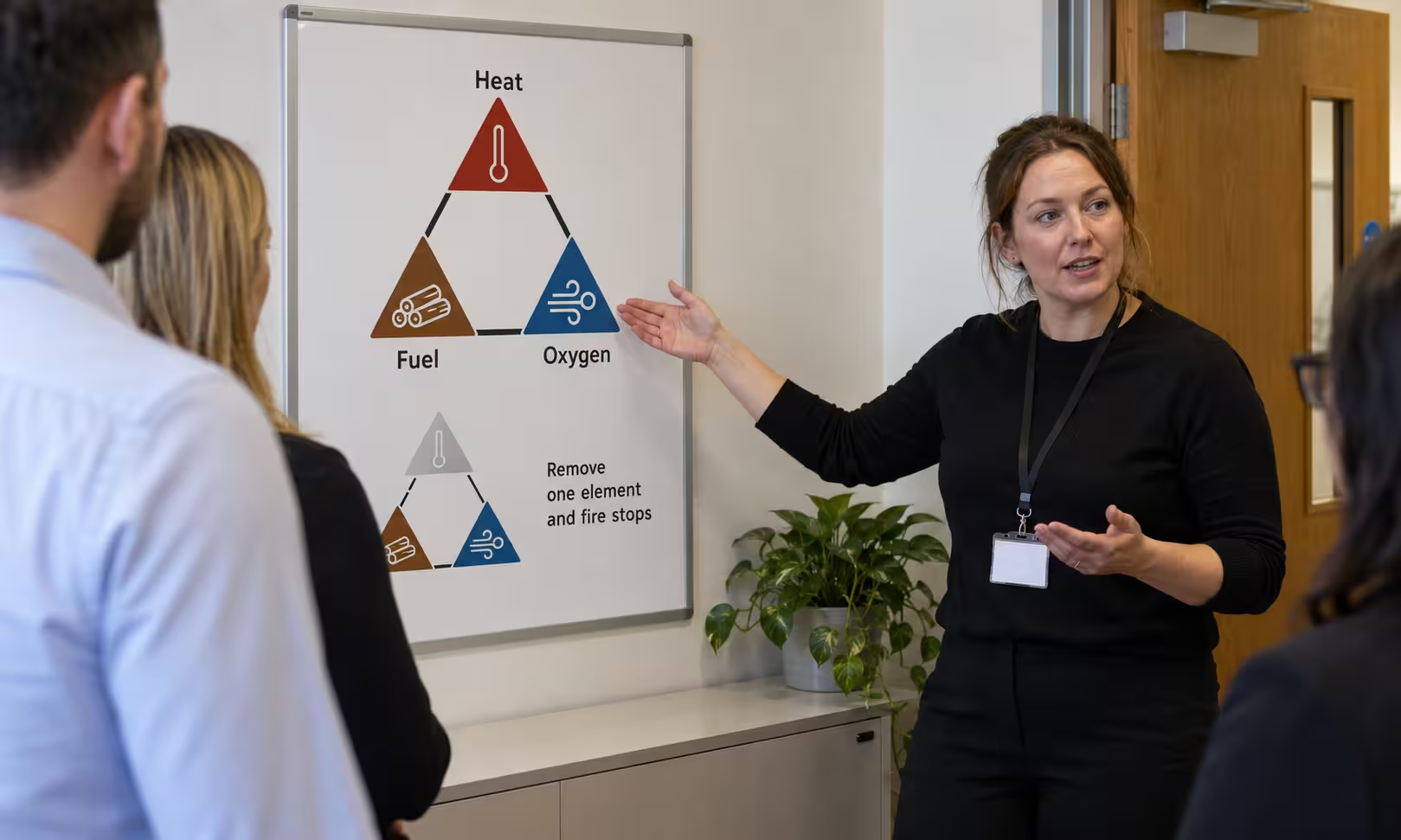
Use the fire triangle and UK fire classes to reason about prevention and extinguisher selection.
Identify and control the common workplace causes of fire, including arson opportunity and lithium-ion battery charging.
Describe the five steps of a fire risk assessment and feed marshal observations into it and its review.
Carry out and log routine checks of alarms, extinguishers, escape routes and fire doors to a defensible standard.
Apply strict criteria to the fight-or-flee decision and use the PASS technique where appropriate.
Perform marshal duties in an evacuation — sweep, report, assembly, roll call and fire service liaison — within their own site’s plan.
Support people who need assistance to evacuate, using PEEPs, GEEPs, refuges and evacuation chairs appropriately.
Career path
Marshal duties are usually held alongside a main role, but they are a recognised foundation for wider safety responsibility. Honest sequencing matters: each step below needs its own training and, at the top end, substantial mentored experience.
Course structure
Fire Safety Law in England & Wales
How Fire Starts, Spreads and Kills
Common Causes and Fire Prevention
Fire Risk Assessment and Your Part In It
Detection, Alarms and Fire-Fighting Equipment
Means of Escape, Fire Doors and Passive Protection
Evacuation and Emergency Response
The Marshal’s Routine: Checks, Records and Culture
Course delivery
Each module closes with an Apply and Reflect exercise. Module 7 opens with a practitioner-support note, plus a 20-question knowledge check with a trainer-only answer key.
Frequently asked questions
Q. Is this a licence or a legal qualification?
No. It is CPD. No law in England and Wales requires a specific ‘fire marshal certificate’; this course is evidence toward the Responsible Person’s training duty, nothing more.
Q. Will it make me a fire risk assessor?
No. It will make you a much better contributor to a fire risk assessment. Assessing complex or sleeping-risk premises requires recognised training and mentored experience.
Q. Is the course accredited, and how many CPD points is it worth?
Accreditation, certifying body and CPD point values are provider decisions and are not claimed here — they must be confirmed truthfully before publication.
Q. Does it apply outside England and Wales?
The law content is specific to England and Wales, with some parts England-only. Scotland and Northern Ireland have separate fire safety regimes.
Q. Is online-only delivery enough?
For the knowledge content, yes. For extinguisher handling, honestly, no — reading PASS is not the same as doing it. Pair this course with supervised hands-on practice.
Q. How often should this training be refreshed?
There is no single statutory interval. Common practice is a refresher every 1–3 years and whenever premises, processes or duties change materially.
Q. Do the statistics and legal references stay valid?
No. Statistics are revised quarterly and fire law has changed three times since 2021. Every figure carries its source and year, and must be re-verified before delivery.
You May Like

CPD COURSE Allergy Awareness Training Meeting the New 2026 School Requirements Jurisdiction: England and Wales · Content current to August 2026 CPD HOURS 35...

CPD COURSE · ENGLAND AND WALES Care Certificate Standards 16-standard knowledge bundle A knowledge refresher for practitioners already working in health and adult social...

CONTINUING PROFESSIONAL DEVELOPMENT · ENGLAND AND WALES Employability Skills with AI For practitioners who already support others into, through or between jobs — a...

CONTINUING PROFESSIONAL DEVELOPMENT · ENGLAND AND WALES Estate Agent Diploma A practitioner course in the law, duties and daily disciplines of residential estate agencies...

CONTINUING PROFESSIONAL DEVELOPMENT · ENGLAND AND WALES Residential Lettings Private rented sector practice under the Renters’ Rights Act 2025 and the Renting Homes (Wales)...
Course Features
- Lectures 10
- Quizzes 2
- Duration Lifetime access
- Skill level All levels
- Language English
- Students 2
- Certificate Yes
- Assessments Self
