
Overview
CPD COURSE · ENGLAND AND WALES Sexual Harassment Awareness including Bullying and Third-Party Harassment Recognition, prevention, response and remedy under the Equality Act 2010, the Worker Protection Act 2023 and the Employment Rights Act 2025. NINE MODULES · 20-QUESTION KNOWLEDGE …

Course Details
Sexual Harassment Awareness
Recognition, prevention, response and remedy under the Equality Act 2010, the Worker Protection Act 2023 and the Employment Rights Act 2025.
PPT Deck
Audio Podcast
Audio Quiz
Infographic
Overview
This course supports practitioners who already deal with harassment and bullying at work — HR and employee-relations staff, line and operational managers, EDI leads, investigators, trade union representatives and health and safety practitioners — and who need a current, England-and-Wales-specific account of the law and of good practice at the point where it is changing. It covers sexual harassment, bullying (which has no legal definition and no standalone claim) and third-party harassment by customers, clients, patients and contractors, which becomes a direct employer liability on 30 October 2026.
Every legal or regulatory point on the slides names the jurisdiction (England and Wales) and carries a visible caveat that Scotland and Northern Ireland differ. Every statistic names its source and year on the slide, and a re-check list collects all of them for verification before each delivery.
Who this course is for
Not designed for people with no workplace experience, or anyone seeking legal training. Practitioners needing to conduct complex or criminal-adjacent investigations should seek specialist investigation training and legal advice.
Learning outcomes
By the end of the course learners will be able to:
Distinguish bullying, harassment, sexual harassment and victimisation as the Equality Act 2010 does, and explain the ‘purpose or effect’ test in section 26.
Recognise verbal, non-verbal, physical and digital sexual harassment, place it on a spectrum, challenge common myths, and notice the indirect signs that it may be happening.
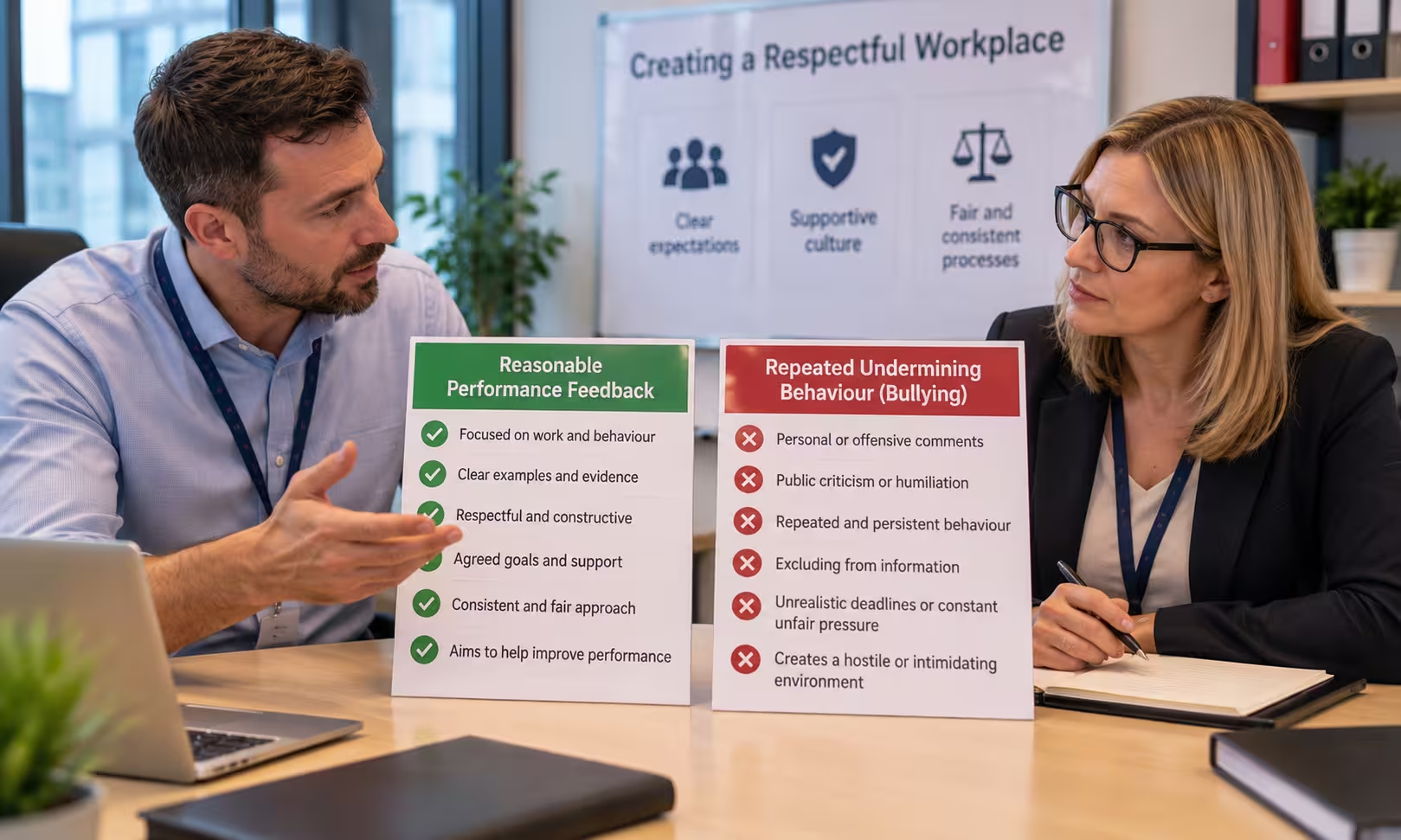
Describe bullying using the Acas description, separate it from firm management, and explain the legal routes that apply when no protected characteristic is involved.
Identify the third parties their workers meet, the risk factors specific to them, and the reasonable steps and incident protocol the law now expects, including the position from 30 October 2026.
Explain the section 40A preventative duty, the EHRC’s eight steps, the consequences of non-compliance, the section 109 defence and current Vento bands.
Carry out a harassment risk assessment, review a policy, design training that would survive a stale-training challenge, and use data to monitor and evaluate.
Respond to a first disclosure safely, explain reporting routes including whistleblowing, choose between informal and formal routes, and plan a fair investigation that avoids common pitfalls.
Support the complainant and the respondent, prevent victimisation, communicate outcomes lawfully, state current time limits and remedies, and signpost to referral pathways.
Apply the 5Ds of bystander intervention, address ‘banter’ in the moment, and build a personal 90-day action plan.
Career path
This course does not confer a role or a title. It supports progression in the roles below, where knowledge of harassment law and practice is increasingly expected. Titles and requirements vary by employer and sector; the routes are typical rather than guaranteed.
Experience of handling concerns; this course as a structured knowledge base; employer training
Case experience; CIPD Level 5 or 7 or equivalent; investigation training; policy work
Investigation training; understanding of evidence, fairness and the Acas Code; often HR or legal background
Union-accredited representative training; TUC Education courses; casework experience
Track record of culture change; governance and board reporting; regulatory engagement
Regulated legal qualifications or organisational recruitment; this course is background only
Course structure
Definitions and the Legal Framework in England and Wales
Recognising Sexual Harassment in Practice
Bullying: Recognition, Impact and Response
Third-Party Harassment: Customers, Clients, Patients and Contractors
The Preventative Duty and Employer Liability
Risk Assessment, Policy and Culture
Receiving Disclosures, Reporting and Investigating
Support, Outcomes and Remedies
Bystanders, Speaking Up and a Respectful Culture
Course delivery and practitioner support
Each module opens with an image slide stating the learning objectives, runs through ten teaching slides in rotating layouts, and closes with an Apply and Reflect slide carrying one external video or article. The whole course concerns harassment, bullying and abuse at work; Modules 2, 3, 7 and 8 contain the most direct material. It is pitched throughout at recognition, response, escalation and referral, never at investigation technique, counselling or method detail, and learners are never invited to share their own experiences in the room.
A practitioner-support note precedes Module 1 and is repeated before Modules 2, 3, 7 and 8: learners may leave at any point without explanation, and support is available whether or not anyone is personally affected — Samaritans on 116 123, the Acas helpline on 0300 123 1100, the Rights of Women sexual harassment at work advice line on 020 7490 0152 (women only, limited hours), and the Rape Crisis England & Wales 24/7 Support Line on 0808 500 2222 — plus a 20-question knowledge check with a trainer-only answer key and rationales.
Frequently asked questions
Q. Is this a qualification?
No. It is continuing professional development. It does not confer a qualification recognised by an awarding organisation, a professional membership, or any licence to practise. If you need a regulated qualification in HR or employment law, look for an Ofqual-recognised awarding organisation in England, a Qualifications Wales-recognised one in Wales, or a CIPD-accredited programme.
Q. Is it accredited, and how many CPD points is it worth?
No accreditation or points value is claimed. The provider must obtain any accreditation independently and confirm it before publishing. A course that overclaims is worse than no course.
Q. Does completing it satisfy the employer’s preventative duty?
No single course does. Training is one of the EHRC’s eight steps; the duty requires a risk assessment, policy, reporting routes, complaint handling, third-party measures and monitoring as well. From 30 October 2026 the test is ‘all reasonable steps’. This course helps practitioners design and evidence those steps; it is not itself compliance.
Q. Is it legal advice?
No. The law is summarised for England and Wales at the level a practitioner needs, with sources named. Anything that affects an individual case — time limits, settlement terms, criminal referral, a live tribunal claim — needs advice from a solicitor, Acas or a trade union.
Q. Which law does it cover?
England and Wales. The Equality Act 2010 applies across Great Britain, but Scotland has separate tribunal presidential guidance and Northern Ireland has its own equality and employment law. The slides say so wherever law appears.
Q. How current is it?
Statistics and statutory references were verified in September 2026 and are dated on the slides. Two commencement dates fall within weeks of that check (1 and 30 October 2026) and regulations on ‘reasonable steps’ and NDAs are still expected. The re-check list must be worked through before each delivery.
Q. How long does it take?
Around two working days, or four half-days, including discussion. Modules 1, 2 and 5 can be run as a half-day core; Module 7 can be run separately for investigators.
Q. Are the videos and articles included?
No. Each module links to one external, publicly available video or article located by search. They are third-party content, not endorsed, and may change or be removed. Open every link before showing it to a group.
Q. What is the pass mark?
The provider sets it. The knowledge check has 20 questions; the answer key gives rationales so that a wrong answer can be discussed rather than simply marked.
Q. Can it be delivered to a mixed audience of managers and HR?
Yes, and that is often the most effective format, because the confidence gap between employers and employees (81% versus 36%) is largely a line-management gap. Module 7 assumes some participants will investigate; others can observe.
You May Like

CPD COURSE Allergy Awareness Training Meeting the New 2026 School Requirements Jurisdiction: England and Wales · Content current to August 2026 CPD HOURS 35...

CPD COURSE · ENGLAND AND WALES Care Certificate Standards 16-standard knowledge bundle A knowledge refresher for practitioners already working in health and adult social...

CONTINUING PROFESSIONAL DEVELOPMENT · ENGLAND AND WALES Employability Skills with AI For practitioners who already support others into, through or between jobs — a...

CONTINUING PROFESSIONAL DEVELOPMENT · ENGLAND AND WALES Estate Agent Diploma A practitioner course in the law, duties and daily disciplines of residential estate agencies...

CONTINUING PROFESSIONAL DEVELOPMENT · ENGLAND AND WALES Residential Lettings Private rented sector practice under the Renters’ Rights Act 2025 and the Renting Homes (Wales)...
Course Features
- Lectures 11
- Quizzes 2
- Duration Lifetime access
- Skill level All levels
- Language English
- Students 2
- Certificate Yes
- Assessments Self
